

The Art of Welcoming & The 7 Laws of the Learner, Law No. 1


**for Part 2 of 2 click here.
THE ART OF WELCOMING
Introduction:
- Environment carries much more power than we give it credit for.
- Think back to the theme song to the beloved sitcom, Cheers: ‘Sometimes you wanna go where everybody knows your name, and they’re always glad you came.” This is description not often applied to local churches. It’s the reason I heard one preacher say, “There’s a reason bars are full and churches are empty.”
- Consider the following biblical passages:
- Some church/small group environments give off an attractive aroma of Christ’s love and peace while others just stink, smelling of formality and a lack of love for, and interest in, people who attend.

Aroma’s
Years ago, during a low season of life, I walked into a local coffee shop called ‘Aroma’s’ and found something striking: the barista took more personal interest in me than many churches I had attended. Frankly, I felt as though I really – really – mattered to this guy. And he was a barista! If i could’ve joined, I would have.
Eventually, while considering this topic after having attended a workshop titled, ‘The Art of Welcoming,’ I created a list of characteristics a church/small group ought to always possess. Using, ‘Aroma’s’ as an acrostic, they are:
- A– ‘amore’ – (Hey, I needed a word for love that started with an ‘a’ other than ‘agape’ because I needed that word later.) Jesus, himself, didn’t mince words when he said our distinguishing characteristic is love for one another (we’ll get to that command shortly). Paul reminded his readers,
- R – ‘rest’ – People come through our doors every week who are fighting battles and carrying burdens we can’t see, and most likely will ever know about. Jesus said,…
-
- I love how the Message Bible paraphrases this passage:
- In your class could be sitting an abused wife, a couple whose marriage is hanging on by a thread, an addict, a man suffering from low self-worth, a personal miserable in their job, a parent estranged from their child, and so on.
- People need to know that, although church environments are notorious for suggesting everyone look and act their best, it’s perfectly ok to not be ok. We must help them know they (1) are not alone, and (2) can lay their burden down at the cross.
-
- O – ‘open’ – People are unique. As a result, they come from familial, social, educational, vocational, socioeconomic, and spiritual backgrounds that are unique to them. Small groups, if they’re not careful, can perpetuate a non-stated tenet strongly suggesting we’ve all got to look and think alike. Paul called this nonsense. In fact, he wrote,
-
- In other words, it’s ok not only to be ‘not ok’, but also to be different. God made us unique. Different.
- The ground is level at the Cross. The ground is level in our small groups as well.
-
- M – ‘me’ – When a person leaves our class (regular attendee or guest) they should be able to honestly say, “They noticed me,” or “They took personal interest in me.”
-
- We’ve all talked to that person who is not really listening, but looking around just waiting for us to take a breath so they can resume talking.
- In our hurried, ego-centric, preoccupied-with-self, never-put-our-phone-down world “considering others” is a command that requires conscious, deliberate effort.
- In a practical sense, the following questions can help break the ice by showing we’re genuinely interested in others: “Where did you grow up?”, “Tell me about your family,” “What do you do for a living?”, “Anything you’re struggling with I can pray about?” “Are you free for coffee sometime?”
- Caveat: of course, some people don’t want to talk for one reason or another. But, this is the exception, not the rule.
- The GR word for “better” (than ourselves) that Paul used has no nuanced meaning that gets lost in translation. It means exactly what it says: to elevate one’s interests above your own.
- C.S. Lewis said that humility is not thinking less of yourself, but thinking of yourself less.
- This principle sparks what we call the ‘human connection.’ As I’ve shared before, people get lost in a crowd (big church), but they connect in a small group. The small group is the fertile ground in which relationships best grow deeply and strongly.
-
- A – ‘agape’ – We begin where we started, with love. This is Christ-like love. (I told you we’d get back to this.) It was Jesus, himself, who said,…
-
- More will be said about this under the Conclusion.
-
- S – ‘safe’ – As I pondered this acrostic, I could have simply used the word ‘aroma.’ But, the ‘possessive s’ immediately drew my mind to one more principle. Read the following familiar passage from the story of the woman caught in adultery.
-
- Who humiliated the woman by making her stand before the group? The church people.
- I’ve been doing what I’m doing for over 38 years. I have seen far too many precious people ravaged by gossip, slander, back-biting, by mean-spirited Christians. Many have never again darkened a door of a church.
- Two sad, but true, adages are:
- Christians don’t gossip, they share ‘prayer requests.’
- The Christian Army is the only army that shoots its wounded.
- Church/small groups should be a place where people know without question what they say in confidence will not be repeated, and that they will be protected rather than judged.
- Further, they should know it is a safe place to ask any and all questions, even to respectfully disagree with what’s been taught.
-
A THEOLOGICAL FRAMEWORK for LEADING SMALL GROUPS

This warning, written by Jesus’ half-brother, should serve as a sobering reminder for all those who’ve answered Christ’s invitation to teach others.
By now, you know there are two words I use repeatedly: shepherding & learning. I do this to, hopefully, instill a paradigm shift related to church leadership. The biblical word pastor literally means shepherd. Let’s look briefly at what God has to say about shepherding:
Biblical Shepherding
A biblical shepherd must demonstrate compassion.
A biblical shepherd must demonstrate faithful stewardship (I’m not talking about money here – I’m talking about shepherding). Notice whose sheep we are shepherding.
- The prophet, Micah, prayed,
“O Lord, protect your people with your shepherd’s staff; lead your flock, your special possession.” – Micah 7:14 (emphasis mine)
- Jesus said [to Peter], “Feed my sheep.” – John 21:15-17 (emphasis mine)
- Whose sheep are they? God’s. That’s a sobering truth.
- Jesus, the Great Shepherd of the sheep, has entrusted us with his most precious possession. It matters greatly to God how we shepherd them – because they’re his. May God find us faithful.
A biblical shepherd must possess a ‘healthy fear.’ A healthy fear is what Solomon meant when we wrote, ‘The fear of the Lord is the beginning of wisdom.’ (Prov. 9:10) A healthy fear reminds us there are expectations, as well as consequences to our actions. My dad had his issues, but one thing he instilled in me was a healthy fear. As a result, I very rarely got into trouble. Look at what Ezekiel prophesied about the false shepherds of Israel, who possessed no fear of God, whatsoever.
-
- Note Ezekiel’s words, ‘They were scattered over the whole earth, and no one searched or looked for them.’ If some of Jesus’ sheep are missing, check on them.
Biblical Learning
This leads us into Law No. 1…
Think for a moment back to your favorite teachers. What do you remember about them that makes them your favorites?
I asked this question to our teachers during our workshop. Here’s what they said:
They loved me. They took a personal interest in me. They encouraged me. They made me feel like I had worth, like what I thought and what I had to say mattered.
Do you notice something in their answers? Not a single characteristic is related to teaching skills.
In Prov 15:2, Solomon records,
The Living Bible paraphrases it this way:
Augustine defined the teacher’s task as
-
‘to teach, to delight, and to influence. To touch the mind, heart and will.’
Until my 10th grade year, I had never attended church more than one Sunday out of a given year (Easter). When a friend invited me to church I found myself in Wayne & Laura Slaton’s class. I can’t recall a single thing they specifically taught (that was a long time ago). But I have crystal clear memory of how they treated me: they loved me, took interest in me, valued me, and gave me a safe place to question and grow strong in my faith. Christ used them to change the vocational trajectory of my life.
My favorite quote regarding the subject of teaching and its relationship to learning is this:
-
You teach what you know, but you reproduce what you are.
Want to impact a life? Because of the way Wayne & Laura Slaton loved me they made me want to be more and more like Jesus. This leads us beautifully into Law No. 1.
Law No. 1: The Law of the Learner

This Law, appropriately listed as No. 1, can be summed up in the following quote by Thom and Joani Schultz in their book, Why Nobody Learns Much of Anything at Church – And How to Fix it:
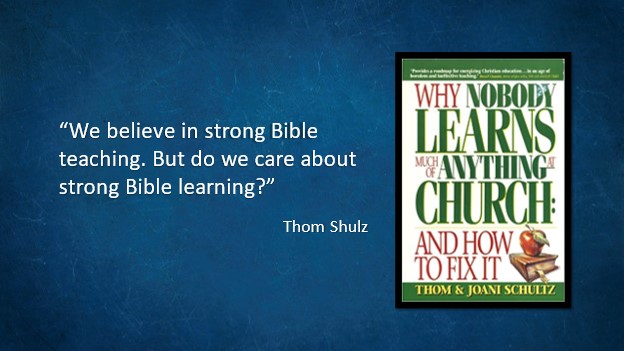
This in no way minimizes the vital importance of prepared, responsible exposition of scripture. What Shulz is saying is that, equal to caring about the content is caring if the content is being grasped, learned, “caught”, whatever word you want to use.
Author of The 7 Laws, Bruce Wilkinson, states,
-
In a sense, all 7 Laws are like a row of dominoes—this first one ultimately controls all the dominoes that follow. Every master teacher I know shares the mindset that it is his or her responsibility to cause the student to learn. But…a tragic divorce has occurred: Teachers have separated themselves from their students and redefined teaching as what the teacher says rather than what the student learns. They believe their primary responsibility is to cover the material in an organized manner (rather than effectively connect with, and communicate the content to, the student.)
Consider the following passage:
-
Now, Israel, pay attention to the statutes and ordinances I am about to teach you, so that you might live and go on to enter and take possession of the land that the Lord, the God of your ancestors, is giving you… Then Moses called all the people of Israel together and said to them: “Listen, Israel, to the statutes and ordinances that I am about to deliver to you today; learn them and be careful to keep them! – Deut. 4:1; 5:1 (emphasis mine)
When the prefix & suffix are removed from the Hebrew word for “teach” and “learn” they are the exact Hebrew word! This root-word literally means, ‘to cause/urge to learn.’
Mark Galli & Craig Brian Larson, in their book, Preaching That Connects, recall a story of a Small Group teacher asking a lady in their class to cover their class while they were out the following week. The teacher shared:
-
“[The woman asking me if she could teach] warned me that she wasn’t a good teacher. ‘What do you mean?’, I asked. ‘I like to teach a subject more than I like to teach people.” (This mindset is antithetical to the model Jesus set for us.)
Our default is to focus on the content of our teaching rather than the communication, and subsequent, learning of the student. Translated to biblical shepherds, this is equivalent to caring more the food we’re offering to the sheep than if the sheep are actually physically benefiting from the food.
***CAVEAT: We can’t control what a student can, or chooses to, learn.
- Sure, Mr. Myagi told Daniel in the 1984 film, The Karate Kid, ‘No bad student; only bad teacher.’ I wish this were true, but it’s not. This is a fallacy, having no truth whatsoever.
- You can assign a poor teacher to the best students and find the students still excel, while you can assign the best teacher to the worst students and find the students still fail.
- We all know multitudes of fantastic teachers who pour their heart and soul into students only to discover that a student has learned little, if anything at all. Why is that? It could be one, or a combination, of many factors.
- Of course, it could be due to a learning disability.
- Or, that student may be from the kind of home context in which I grew up i.e. extreme violence, addiction, zero parental involvement, fear, anxiety, an acute inability to focus or comprehend, etc.
- Or, they may have simply made up their mind they have no interest in learning. It’s the old, “you can lead a horse to water but you can’t make them drink,” principle.
- Bottom line, sometimes the ability for these types of students to learn has nothing to do with the valiant effort of their teacher.
- Wilkinson affirms,

- Wilkinson serves up some clarification by contrasting the Law of the Learner with the Law of the Student.
-
The Law of the Student states that the student is responsible to learn, regardless of the quality of the teacher.
-
- In sum – Even the Master Teacher Himself had students with no intention of learning.
- The Rich Young Ruler (Mark 10:17-27) represents the entitled and arrogant.
- The “many” in John 6:66 who, in essence, told Jesus “whatever” and never followed him again represent the indifferent, the “who cares?” attitude.
- Finally, on a more intense level, the Sadducees and Pharisees, who represent anger and pride, attacked not only Jesus’ content but also His reputation and eventually His life.
- Wilkinson adds:
-
“Don’t allow yourself to retreat into the false conceit that when you teach for the right reasons and with all your heart, everything is automatically going to be wonderful.”
-
CONTENT vs. COMMUNICATION
Wilkinson writes,

In other words, the best content is neutered if the students can’t understand it as it is being taught.
But we pride ourselves in appearing ‘scholarly’, right? Well, we all know some who do.
Galli & Larson:
-
“When we are more impressed with our teaching than the student it becomes a slippery slope.”
At its root, this is undiluted pride. “I want to sound smart. I want to remind the sheep I know more than they do, etc. Whether or not they get it is their fault.”
-
“For pride is spiritual cancer: it eats up the very possibility of…love and common sense.” ―C.S. Lewis
Teach in a way that your students can pick up what you’re putting down. Never think for a moment everyone in your class has even a rudimentary understanding of scripture (biblical illiteracy is at an alarming level among Christians).
Remember, teaching, according to God, is “causing to learn.”
- This is precisely why Jesus would pick up a handful of salt while walking along with his disciples, or point to a city on a hill, or compare the kingdom of heaven to a treasure hidden in a field, and so on. He was always connecting with his listeners, finding common ground with the world in which they live, doing whatever was necessary to help them ‘connect the dots.’
- Always work as much on communication as on content.
When preparing your content and communication keep in mind the old saying, “The mind can only comprehend what the seat can endure.”
- We have a short amount of time to connect with our class and communicate in a way they can learn the content (which is why I often urge you to start on time).
- So, never hesitate to edit your content. Keep it simple. As one preacher said, “Place the hay where the sheep can reach it.”
- Keep in mind, you’ve been working on your lesson for days. You’ve sorted through the logic and greater context of the lesson. But, your class is hearing it for the very first time. They deserve to have the content communicated in a manner in which they can think about it and sort it out through discussion.
- Spurgeon, who knew a thing or two about teaching, once said,
-
“We may say too much in a single sermon; we may give a field of wheat instead of a loaf of bread.”
-
Content that is theologically and doctrinely sound is of utmost importance. There’s no disagreement on this. But, if our communication of the content is of little importance the content is wasted.
FINAL WORD
A picture says a thousand words.
The following short video is the story of Derek Redmond and his 400 meter race in the 1992 Summer Olympics in Barcelona, Spain.
Without spoiling the story, the aid Redmond receives is representative of the help and comfort we receive from God.
Each Sunday you have people in your class who are fighting battles of which you know nothing. Little do you know that Christ is using you to be his hands and feet to help those hurting people.

April 2021
Nick Watts